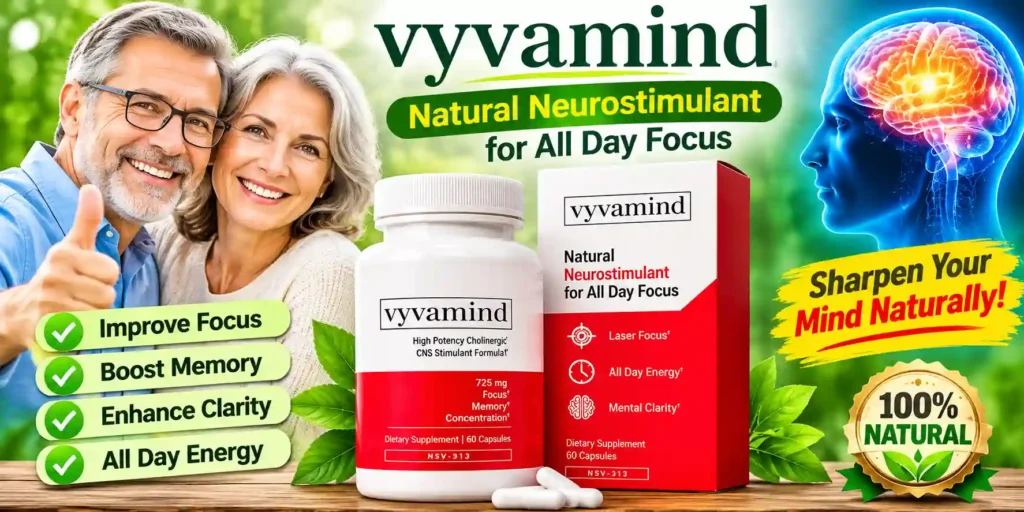
Nootropics, the supplements sold as “brain boosters,” have become a multi-million-dollar category, and few products are advertised as aggressively as Vyvamind. Its website promises intense focus, no crash, no jitters and protection against burnout. But how much of that holds up when you look at the formula, the doses and the actual research?
What Is Vyvamind?
Vyvamind (product code NSV-313) is an over-the-counter nootropic capsule from SAP Nutrition. The brand calls it a “neurostimulant and focus aid” built for mentally demanding situations, and it targets students, programmers, traders, gamers, entrepreneurs and athletes who want to stay “locked in” during long work sessions.
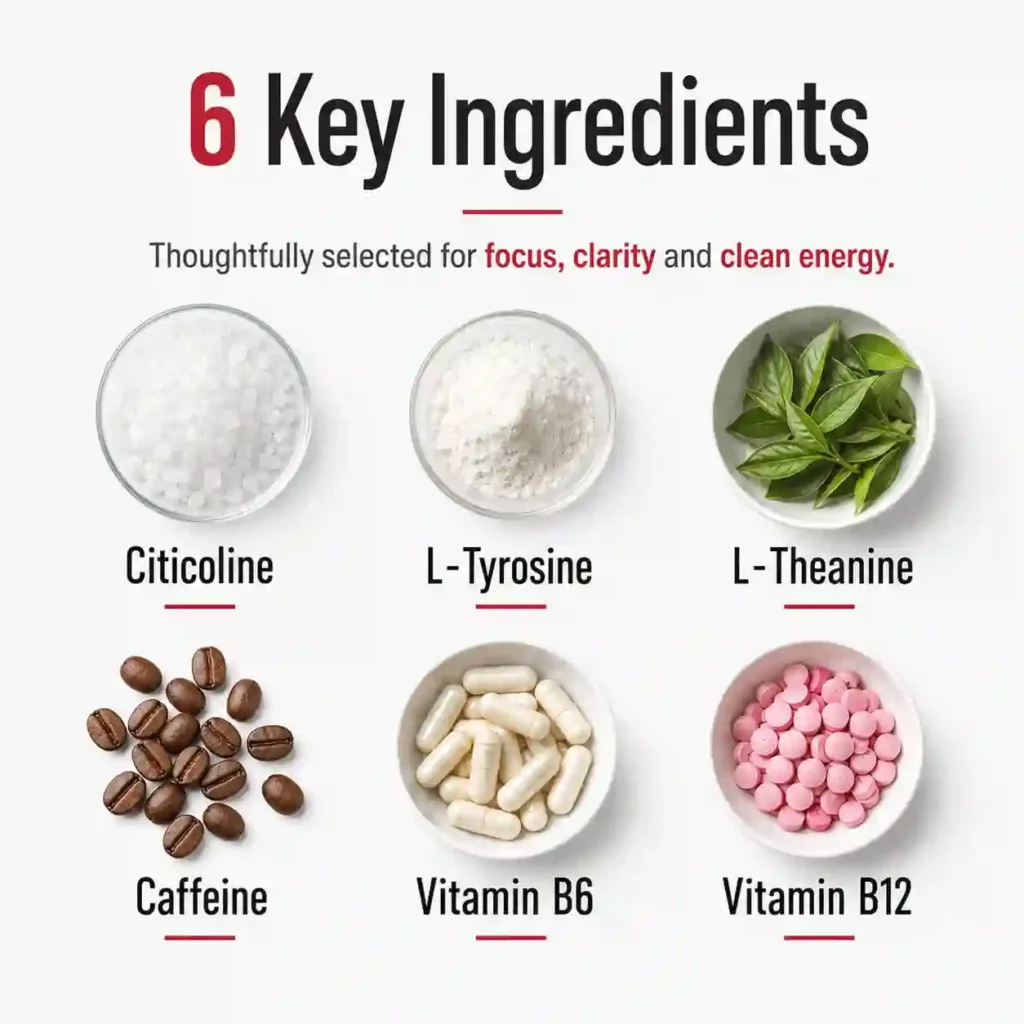
Legally, it is a dietary supplement, not a drug. It needs no prescription, and the brand states it contains no controlled substances. The formula is a stack of six active ingredients: citicoline, caffeine, L-theanine, L-tyrosine, vitamin B6 and vitamin B12. None of these is exotic. Each is widely sold on its own, and the pitch is that the combination, at specific doses, works better together.
The Formula: Ingredients and Doses
According to the brand, one serving (2 capsules) contains:
| Ingredient | Amount per serving | Claimed role |
|---|---|---|
| Citicoline | 200 mg | Acetylcholine support, focus, memory |
| Caffeine anhydrous | 75 mg | Alertness, energy, attention |
| L-Theanine | 150 mg | Calm focus, smooths out caffeine |
| L-Tyrosine | 300 mg | Dopamine precursor, stress resilience |
| Vitamin B6 (pyridoxine HCl) | 2.5 mg | Neurotransmitter synthesis |
| Vitamin B12 (methylcobalamin) | 50 mcg | Nerve and energy metabolism |
Here is what each ingredient does and what the research says about it.
Caffeine (75 mg)
Caffeine blocks adenosine receptors, the brain signal that tells you to feel tired. It is among the best-studied cognitive aids there is. At 75 mg, Vyvamind’s dose is a little under one cup of coffee. An independent review by Illuminate Labs described it as relatively low but still within the effective range. That is also good news for caffeine-sensitive people, since the dose is modest.
L-Theanine (150 mg)
L-theanine is an amino acid found in tea. The caffeine and theanine pairing is the best-supported part of the formula. A 2014 systematic review and meta-analysis of 11 randomized placebo-controlled studies found moderate effects favoring the combination on alertness and attention-switching accuracy during the first two hours after a dose. A more recent meta-analysis of randomized trials concluded that theanine plus caffeine, and theanine alone, possibly improve attention and mood, while cautioning that the number of studies was small and doses varied. Vyvamind’s 2:1 theanine-to-caffeine ratio matches the ratio the brand’s own doctor endorsement highlights.
Citicoline (200 mg)
Citicoline is a choline source used in many memory supplements. Trials show benefits mainly in older adults with age-related memory decline, usually at 500 mg per day. A study of healthy women aged 40 to 60 found attention improvements at 250 mg and 500 mg over 28 days. Vyvamind’s 200 mg sits below the doses used in most of this research. Reviews from independent groups also note that evidence in healthy people who already perform well is mixed, with some benefit appearing mostly in low performers.
L-Tyrosine (300 mg)
Tyrosine is a building block for dopamine and noradrenaline. It has the most support under acute stress, such as sleep deprivation or demanding multitasking, and the brand itself says so. The independent analysis found a clinical trial showing cognitive benefits, but at a dose of 2,000 mg, more than six times what Vyvamind provides. So while the ingredient is legitimate, whether 300 mg produces a noticeable effect remains uncertain.
Vitamins B6 and B12 (2.5 mg and 50 mcg)
B vitamins are essential for nerve function and energy metabolism, and B6 is needed to convert tyrosine into dopamine. But Illuminate Labs found no clinical evidence that supplementing these two vitamins improves cognition in people who are not deficient. They are cheap, safe at these doses and sensible additions, but they are unlikely to be the reason anyone feels sharper.
How to Take Vyvamind
The brand’s recommended serving is 2 capsules with water. A bottle holds 60 capsules, which is 30 servings, or a one-month supply. According to the brand, most users report increased alertness within about 30 to 60 minutes, with fuller benefits building over several days of consistent use.
The brand notes that some customers double the serving when they need extra energy, but it strongly recommends staying with the standard serving. Doubling would push caffeine to 150 mg and tyrosine to 600 mg per dose, and the brand itself warns that exceeding the recommended dose raises the risk of side effects. As with any caffeinated product, avoid taking it late in the day if you are sensitive to its effect on sleep.
The Claimed Benefits and the “4-Week Journey”
The website lays out a typical timeline:
- Week 1: more energy and alertness.
- Week 2: sharper focus and fewer distractions.
- Week 3: better memory, quicker problem solving, sustained attention.
- Week 4: benefits become part of everyday performance.
Other headline claims include “instant” relief from brain fog, accelerated processing, motivation without a crash, stress and anxiety control, and long-term “burnout protection.”
Some of this is plausible. A caffeine and theanine combination can plausibly deliver alertness and attention benefits within an hour or two. But the week-by-week timeline, the “burnout protection” and the “no crash, no jitters” promises are marketing language. I could not find clinical trial data on the finished product that supports them.
Claims vs. Evidence: A Reality Check
“Clinically proven dosages.” The brand says each serving uses clinically proven doses. An independent analyst found that the studies the brand cited used much higher doses: 500 or 2,000 mg of citicoline instead of 200 mg, and 20 mg of B6 instead of 2.5 mg. The same analysis found no sign that Vyvamind itself has been clinically tested. On the brand’s research page, the claim that citicoline can raise brain energy by 13.6% is still present when I checked, even though the independent reviewers said it should be treated with caution.
“Non-addictive.” Vyvamind contains no controlled substances. But caffeine is a mild stimulant, and regular use can lead to tolerance and dependence for some people. “Non-addictive” is best read as “not an amphetamine-type drug,” not as “impossible to rely on.”
“FDA approved facilities.” The FDA does not approve dietary supplements before they are sold, and it does not evaluate their effectiveness. The brand’s own FAQ uses the wording “FDA inspected” and cGMP certified, which is a different and more accurate description. Manufacturing standards and facility inspections are good signs, but they are not an endorsement of the product’s effects.
“No side effects.” No stimulant-containing product can honestly promise this. See the next section.
None of this means the formula is junk. The ingredients are legitimate, and the caffeine and theanine pair has real support. It means that the marketing claims more certainty than the research can give.
Side Effects and Safety
For most healthy adults, the formula looks low-risk. The independent review concluded that Vyvamind is not likely to cause side effects in otherwise healthy adults, because every ingredient is well studied, none is dosed dangerously high, and the caffeine content is less than a cup of coffee. Theanine’s calming profile may also soften caffeine’s edge.
Still, possible effects include:
- headaches, particularly early on
- restlessness, nervousness or a racing heart in caffeine-sensitive people
- digestive discomfort, which may be reduced by taking it with food
- trouble sleeping if taken in the afternoon or evening
Higher-than-recommended doses, or stacking Vyvamind with coffee, energy drinks or pre-workout powders, raise the odds of trouble. Regulators commonly cite roughly 400 mg of caffeine a day as a level not generally linked with negative effects in most healthy adults, so total intake from all sources matters.
Talk to a doctor or pharmacist first if you:
- are pregnant or breastfeeding, or under 18 (the brand advises against use)
- have a heart condition, high blood pressure, anxiety disorder or sleep problems
- take prescription medicines, particularly antidepressants, MAOIs or thyroid medication, since tyrosine can interact with some of these
- have ADHD and are considering replacing prescribed treatment
That last point matters. Some promotional articles pitch Vyvamind as an “Adderall alternative.” It is not a replacement for prescription ADHD medication, which is a different class of drug with a different evidence base. Do not stop or change prescribed treatment based on a supplement’s marketing.

Quality, Manufacturing and Certifications
The brand says Vyvamind is made in the USA in a cGMP-certified facility in Florida, is third-party tested for purity and potency, and is free from gluten, soy, milk and peanuts, as well as vegan-friendly and non-GMO. Those are positive claims. On the pages I reviewed, however, I did not see published lab reports or certificates of analysis, so these claims rest on the company’s word. If this matters to you, ask the seller for batch test documentation.
Because some nootropic supplements have been found to contain undeclared or unapproved drugs, buying from the genuine seller matters. Vyvamind’s own site warns that copies sold elsewhere may be counterfeit.
Price and Where to Buy
At the time of writing, the brand says Vyvamind is sold exclusively through its official Amazon store at $56.99 per bottle, with free delivery and a Subscribe & Save option. That works out to about $1.90 per serving. The brand says purchases are covered by Amazon’s returns process and buyer protection.
This has changed over time: earlier reviews said it was sold only on the brand’s own site, and older articles still mention discounts and guarantees that may no longer apply. Always check the current listing, and if you are outside the US, check shipping and import rules before ordering.
The independent analysis called the product expensive, and with good reason: the only two ingredients it considered adequately dosed, caffeine and theanine, are inexpensive to buy separately.
What Users Say, and Why You Should Be Careful With Reviews
The brand displays a 4.8 rating from more than a thousand reviews, and claims that over 95% of customers noticed more energy, around 93% better focus, and 90% greater productivity. No methodology is given for these percentages, and the testimonials on the page are curated. Independent feedback is thinner and less uniform: some users on third-party platforms praise it, while at least one creator online called it a waste of money.
Be careful with the “reviews” you find in search results. Many top-ranking pages are labeled as sponsored content or partner content, and many follow the same template with enthusiastic wording and a buy link. These are advertising, not independent evaluation. The more cautious analyses are the ones that examine doses against published trials.
Pros and Cons
Pros
- Legitimate, well-known ingredients, with no exotic or hidden proprietary blend
- Caffeine and theanine in a sensible 1:2 ratio with real research support
- Moderate caffeine dose, friendlier to sensitive users than many pre-workouts
- Clear dose disclosure and no harmful fillers, per the independent review
Cons
- Citicoline and tyrosine are dosed below the levels in most supporting studies
- B vitamins add little for people who are not deficient
- No published clinical trial on the finished product
- Marketing claims such as “clinically proven,” “no crash,” “non-addictive” and “burnout protection” go beyond the evidence
- Relatively expensive for what it contains
- Third-party test results not visible
Alternatives to Consider
- Coffee or tea plus L-theanine. A cup of coffee or tea with a 100 to 200 mg theanine capsule reproduces the best-evidenced part of Vyvamind for a fraction of the price.
- Other multi-ingredient nootropics. Comparison articles often pair Vyvamind with NooCube, and the independent reviewer favored Mind Lab Pro, citing two published trials on that product. Evaluate any such product the same way: doses, trial evidence and transparency.
- The basics. Sleep, exercise, hydration and regular breaks usually matter more for focus than any pill.
Who Might Benefit, and Who Should Skip It
Vyvamind may suit healthy adults who already enjoy caffeine, want a smoother version of it, and are comfortable paying a premium for convenience.
It is probably not for you if you are sensitive to stimulants, have a heart or anxiety condition, are pregnant or breastfeeding, take interacting medications, are under 18, or expect dramatic long-term memory gains.
Frequently Asked Questions
No supplement is FDA approved for effectiveness before sale. The brand says it is made in a cGMP-certified, FDA-inspected facility, which is a manufacturing claim.
No. Adderall is a prescription amphetamine medication. Vyvamind is a caffeine-based supplement with amino acids and vitamins. It should not be used as a substitute for prescribed treatment.
The brand says most people feel alertness within 30 to 60 minutes. Any effects beyond that, such as memory improvements, are not well documented for this specific product.
The brand describes ongoing use, but tolerance to caffeine can build, so some people save it for demanding days. Ask your doctor if you have health conditions.
The brand’s official Amazon listing. Avoid unauthorized sellers.
Final Verdict
Vyvamind is a reasonably designed, transparently labeled caffeine and theanine stack with a few supporting nutrients. For healthy adults, it is unlikely to be harmful, and the caffeine and theanine pairing can plausibly sharpen alertness and attention for a couple of hours.
Where it falls short is evidence and value. Several ingredients are dosed below the levels used in the research the brand leans on, no clinical trial of the finished product appears to exist, and the marketing makes promises such as “clinically proven,” “no crash” and “burnout protection” that cannot be verified. At roughly $1.90 per serving, you are paying a premium for a formula whose strongest component you can assemble yourself for much less.
Bottom line: a decent but unremarkable product with louder marketing than evidence. Try it if you want convenience and tolerate caffeine well, keep your expectations modest, and do not treat it as a medical solution for focus problems. If focus difficulties are persistent, speak with a healthcare professional.
Sources
- Illuminate Labs, Vyvamind Review: https://illuminatelabs.org/blogs/health/vyvamind-review
- Nutrition Reviews (2014), systematic review and meta-analysis of L-theanine, caffeine and EGCG: https://pubmed.ncbi.nlm.nih.gov/24946991/
- Proceedings of the Nutrition Society, meta-analysis of tea, theanine and theanine plus caffeine: https://www.cambridge.org/core/journals/proceedings-of-the-nutrition-society/article/effects-of-tea-camellia-sinensis-or-its-bioactive-compounds-ltheanine-or-ltheanine-plus-caffeine-on-cognition-sleep-and-mood-in-healthy-participants-a-systematic-review-and-metaanalysis-of-randomised-controlled-trials/1F0ABB804FC3E74DCC0799E0403627DD
- Alzheimer’s Drug Discovery Foundation, Citicoline evidence summary: https://alzdiscovery.org/cognitive-vitality/ratings/citicoline
- Nakazaki et al., Citicoline and memory in healthy older adults: https://pmc.ncbi.nlm.nih.gov/articles/PMC8349115
- Nutritional Outlook, citicoline study in healthy middle-aged women: https://nutritionaloutlook.com/view/new-citicoline-cognitive-study-focuses-healthy-subjects
- Operation Supplement Safety, Nootropics: drugs vs dietary supplements: https://www.opss.org/article/nootropics-drugs-or-supplements
